
DeKalb IL Epoxy Flooring installs epoxy garage floor systems in DeKalb, IL, serving surrounding cities including Cortland, Sycamore, Genoa, Elburn and Rochelle. Our 20+ years of floor work have shown us that a garage floor lives or dies on what happens before the first coat, so every job starts with a diamond-ground slab and a moisture reading. The coating itself is chosen after that, not before.
A two-car garage in northern Illinois asks a lot of a floor. It takes hot tires, dropped tools, oil and antifreeze drips, and months of salt-laden slush melting off the car. We build garage systems thick enough and sealed tightly enough to take all of that, with a topcoat that resists the brine and the sun coming through the open door.
Before you sign anything, you get a proposal that names the products, the layers and the finished thickness of the floor. We also walk you through what the warranty does not cover, starting with moisture, so the conversation about risk happens before the job rather than after it.
Epoxy Garage Floor Systems We Install
Full Flake Epoxy Garage Floors
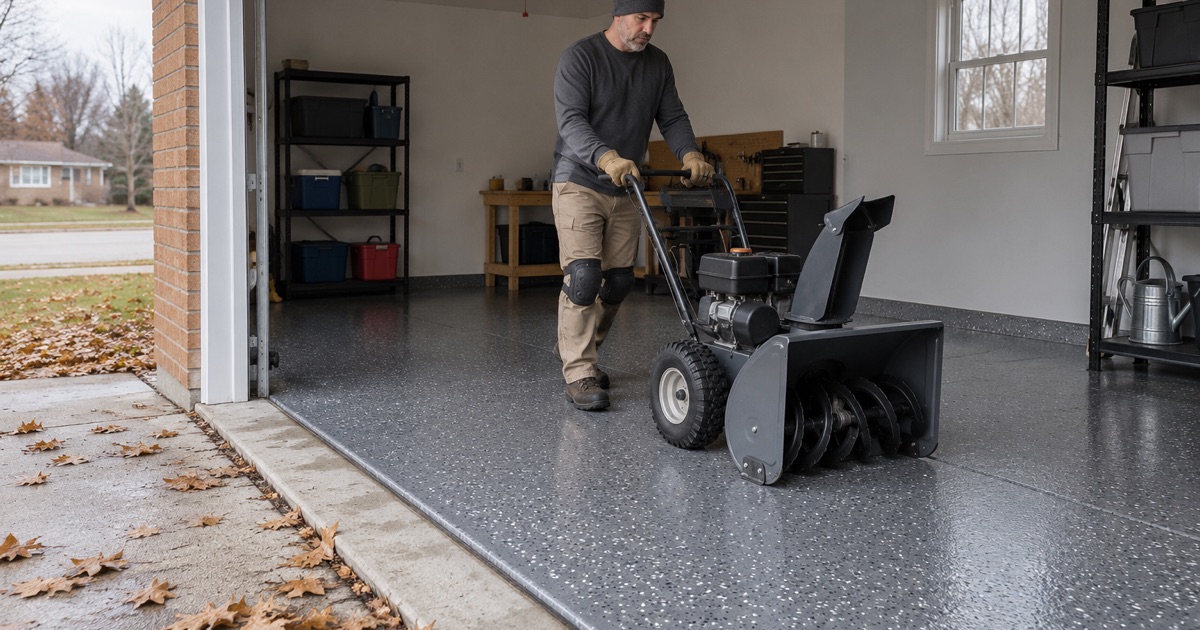
The most popular garage floor we install is a full flake system: a pigmented epoxy base coat, a broadcast of vinyl flakes to refusal, and a clear topcoat over the top. The flakes hide small surface flaws in the concrete and give the floor a speckled, textured finish. They also add grip underfoot when snowmelt comes off the car.
Flake blends range from subtle grays and tans to bolder mixes, and the chip size changes how busy the floor reads. A full broadcast covers every inch of base coat, while a partial broadcast leaves more solid color showing. We bring samples so you can judge the blend under your own garage lights before deciding.
Solid Color and Quartz Garage Coatings
A solid color epoxy floor is a cleaner, simpler look, and it makes a dropped bolt or a fluid leak easy to spot. It suits a workshop garage where the floor is a work surface first. We can add an anti-slip additive to the topcoat so a plain floor still grips when wet.
Quartz aggregate broadcast is the heavier-duty choice, locking sand-sized colored granules into the resin for a gritty, durable texture. It holds up well where jacks, creepers and rolling toolboxes work the floor every day. The trade-off is that a rougher surface takes a little more effort to mop.
Polyaspartic Topcoats Over an Epoxy Base
Many of our garage floors pair a 100% solids epoxy base with a polyaspartic topcoat. The epoxy builds thickness and bonds deeply into the ground slab, while the polyaspartic layer cures fast and resists yellowing from sunlight. That combination gives a garage the strengths of both products.
Polyaspartic is often sold as a one-day floor that is stronger than epoxy, and the marketing tends to skip the part about preparation. A fast-curing topcoat over a poorly prepared or damp slab fails just as surely as anything else. We use polyaspartic where it helps, and the proposal says exactly where it goes.
Preparing a DeKalb Garage Slab for Coating
Diamond Grinding to an Open Profile
We never acid etch a garage floor. Every slab is ground with diamond tooling or shot blasted to an ICRI CSP profile matched to the primer, which removes laitance, sealers and old paint and opens the surface. The grinders run with dust collection attached, so the dust goes into a bag rather than down a floor drain.
The edges get the same attention as the open floor, using hand grinders along the walls, around the door track and at the step into the house. Those edges are exactly where salt and water try to get under a coating. A floor that is only ground in the middle tends to lift at the perimeter first.
Moisture Testing Before Choosing a System
Many garage slabs have no vapor retarder under them, since IRC R506.2.3 exempts garage floors from the requirement that applies under living space. Moisture moving up through that bare slab can lift a coating from below. We test with ASTM F1869 calcium chloride kits or ASTM F2170 relative humidity probes before recommending any product.
When the reading is high, the system changes to include a moisture-mitigation primer designed to tolerate vapor coming through the slab. When it is low, a standard primer or direct-to-concrete base coat is fine. Either way, the decision is based on a number recorded in your file rather than a guess.
Cracks, Joints and Old Coatings
We read every crack and control joint before quoting a garage floor. Hairline shrinkage cracks are routed and filled with a semi-rigid polyurea that grinds flush, while wider or displaced cracks get a closer look to decide whether the slab is still moving. Control joints can be filled and coated over or kept open, and we explain the trade-off.
Sometimes a garage slab is too heaved, scaled or broken for a coating to make sense, and we tell you so. A replacement slab has to follow DeKalb’s building code, including the IRC R309.1 rules for floor slope toward the door and the 4-inch curb at the house wall. Those details decide where the new coating will eventually end.
Built for Northern Illinois Winters
Standing Up to Rock Salt and Calcium Chloride Brine
Road crews spread rock salt and calcium chloride brine all winter, and a car carries it into the garage on every trip. On bare concrete, that salty water soaks in and freezes, slowly scaling the surface away. A properly built garage coating keeps the brine on top, where it can be squeegeed out the door.
We pick chemical-resistant topcoats for garage floors and seal the perimeter carefully, because brine finds any gap at the edge. We also explain how to keep the floor clean through a winter, since dried salt left for months is harder on any surface than salt rinsed away weekly.
Preventing Hot Tire Pickup
Hot tire pickup happens when warm tires soften a thin coating, grip it as they cool, and peel it off when the car backs out. It is most common with thin retail kits laid over etched concrete. A properly ground slab with a full-thickness system bonds deeply enough that the tires cannot lift it.
The finished thickness of the floor is written in our proposal so you can see how much material is going down. We also tell you how long to wait before driving on the new floor, because even a strong system needs time to cure fully before hot tires sit on it.
Cold Garages, Dew Point and Cure Timing
Epoxy and polyaspartic resins need a warm slab to cure properly, and a cold slab close to the dew point can collect condensation on fresh resin, causing amine blush and adhesion problems. We measure the slab temperature and the dew point spread at the surface before coating. If the numbers are wrong, the job waits.
A heated, insulated garage can be coated in the middle of winter without trouble. An unheated garage in a January cold snap is a different story, and we would rather schedule it for spring than install a floor that never cures properly. We tell you which kind of garage you have before the calendar is set.
Cost, Code and Paperwork
What an Epoxy Garage Floor Costs
We price garage floors per square foot for the system we propose after seeing the slab. Coating removal, crack and joint repair, a moisture-mitigation primer, full versus partial flake, and the choice of topcoat all move the number. A one-car garage with a clean slab and a three-car garage with an old coating will price very differently.
The proposal lists each layer of the system and the finished thickness, so you can compare our quote against others on equal terms. A lower price usually reflects thinner material or lighter preparation, and the proposal makes that difference visible.
Warranty Exclusions and Your Contract
We read out the warranty exclusions before the job is sold, with moisture coming up through the slab named first. Hot tire damage on an uncured floor, chemicals left standing and cracks that open after installation are other common exclusions. Knowing them up front is part of choosing a system.
Every garage job gets a written contract and the Home Repair: Know Your Consumer Rights pamphlet before work begins, as the Illinois Home Repair and Remodeling Act requires. Since Illinois has no state license for floor coating work, we also confirm your town’s registration and insurance rules before scheduling.
Our Step-by-Step Epoxy Garage Floor Process
Step 1: Walk-Through and Moisture Test
We measure the garage, test the slab for moisture and look at every crack, joint and old coating. You see samples and talk through the system options and finishes. The written proposal follows with the products, the layers and the price.
Step 2: Grinding and Repairs
The slab is diamond ground across the floor and along every edge, with the dust collected as we work. Cracks, spalls and pits are filled and ground flush. We vacuum the floor thoroughly so the primer goes onto clean concrete.
Step 3: Base Coat and Broadcast
The primer or moisture-mitigation primer goes down first, followed by the pigmented base coat. Flakes or quartz are broadcast into the wet resin, then the excess is scraped and vacuumed once it cures. The surface is checked for high spots before the topcoat.
Step 4: Topcoat and Return to Service
The topcoat seals the broadcast and sets the final sheen and texture. We walk the finished floor with you and go over the cure times, the date for parking and how to care for the floor through its first winter.
- 20+ Years of Floor Work
- Moisture Testing in Every Scope
- Written Proposals and Contracts