Epoxy Flooring in DeKalb, IL, Ground Open and Tested First

Garage, basement, shop and commercial floors built on a mechanically prepared, moisture-tested slab, with the product and thickness named in writing.

DeKalb IL Epoxy Flooring brings 20+ years of floor coating work to DeKalb, IL, installing epoxy garage floors, polyaspartic coatings, basement floor epoxy, polished concrete and commercial and industrial epoxy flooring. Every floor starts the same way, with the slab ground open by machine and tested for moisture before any product is chosen. We take on homes, farm shops, warehouses, restaurant kitchens and storefronts.

A coated floor is only as good as the concrete under it and the preparation of that concrete. Most coating failures we are called to look at trace back to a slab that was acid etched instead of ground, a moisture problem nobody measured, or a crack coated over without being read. We build our scope of work around those three failures, so the money goes into the steps that decide whether a floor lasts.

What you get from us is a written proposal naming the product, the system build and the finished thickness, so you can check what was quoted against what went down. We also tell you when a slab is not ready for a coating, when it needs repair first, and when the honest answer is to replace the concrete.

Get Your Free Quote

Fast response • No obligation

So we can reach you about your request.

So we can send you a confirmation after you submit this inquiry form.

  • 20+ Years of Floor Work
  • Moisture Testing in Every Scope
  • Written Proposals and Contracts

What we do

Our Services

Epoxy and polyaspartic floor coatings for DeKalb, IL garages, basements and shops

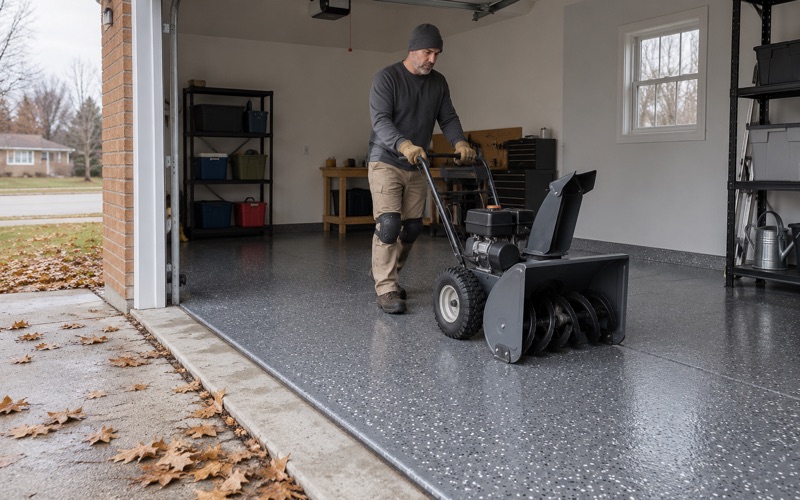
A snow blower wheeled into its corner over a new charcoal flake garage floor in DeKalb ahead of winter.

Epoxy Garage Floor

Flake, solid color and polyaspartic garage floor systems over a diamond-ground, moisture-tested slab, built to shrug off winter salt.

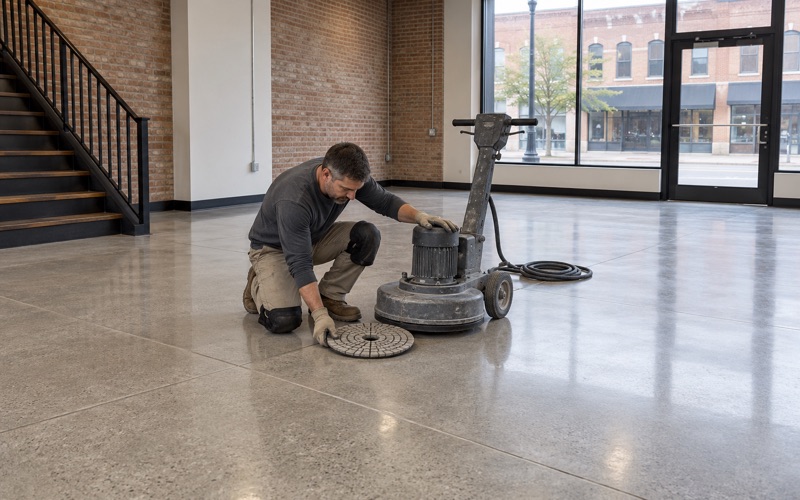
A diamond polishing pad set down beside a planetary polisher on a polished gray concrete floor in a DeKalb storefront.

Polished Concrete Floors

Ground, densified and polished concrete for commercial spaces and homes, with the aggregate exposure and sheen chosen before work starts.

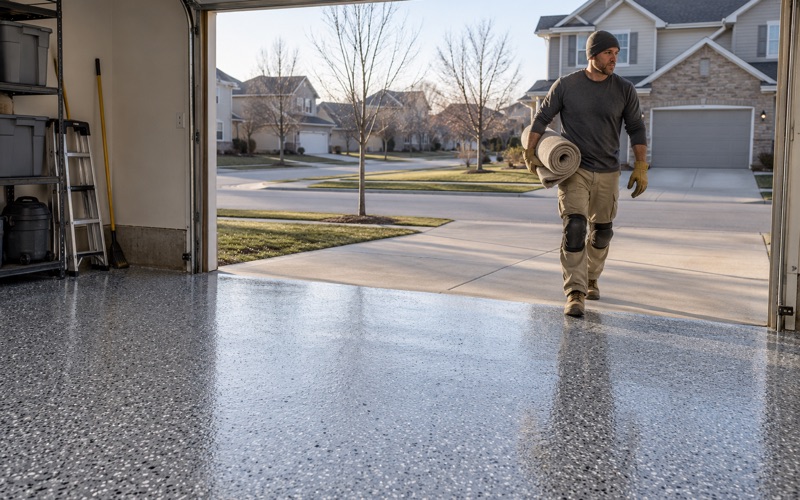
A rolled drop cloth carried out of a DeKalb garage across the apron after a one-day polyaspartic flake install.

Polyaspartic Floor Coating

Fast-curing, UV-stable polyaspartic floor coatings for garages and commercial floors, installed over a ground and moisture-tested slab.

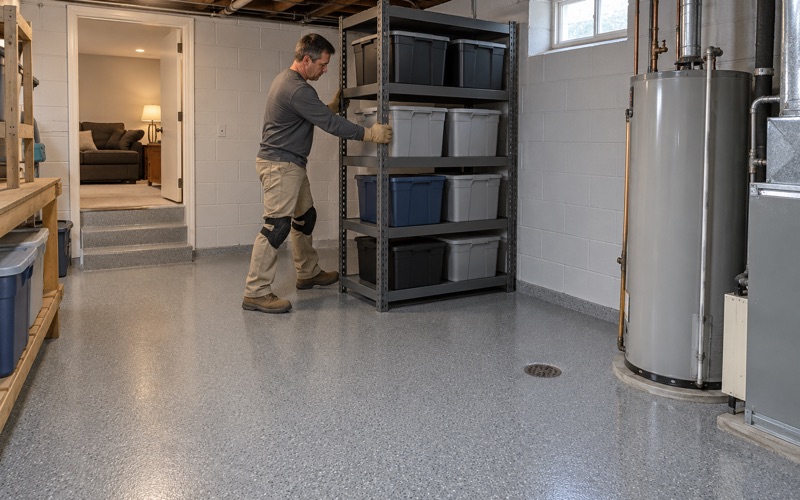
A steel shelving unit slid back against the block wall on a new gray epoxy basement floor in a DeKalb home.

Basement Floor Epoxy

Basement floor coatings built on a moisture test, with sump pits, floor drains and efflorescence handled before any epoxy goes down.

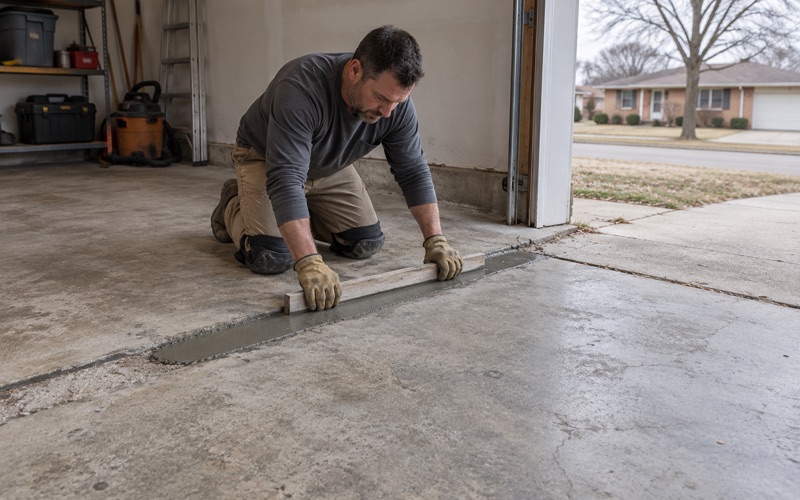
A wooden screed board drawn across a filled spall at a garage slab joint in DeKalb to check it sits flush.

Concrete Floor Repair

Crack filling, spall and joint repair, and resurfacing for garage, basement and commercial slabs, judged honestly before any coating.

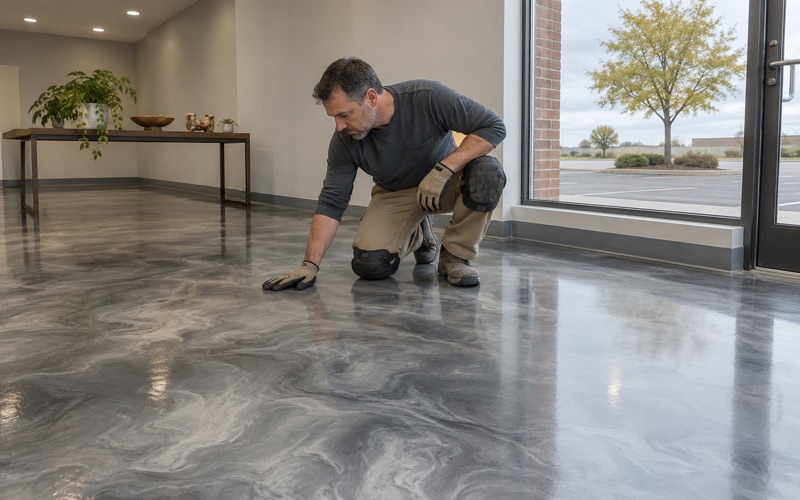
A finisher's flat palm on a cured silver and charcoal metallic epoxy floor in a DeKalb showroom.

Metallic Epoxy Floor

Marbled metallic epoxy floors for basements, showrooms, offices and garages, poured over a flat, moisture-tested and ground slab.

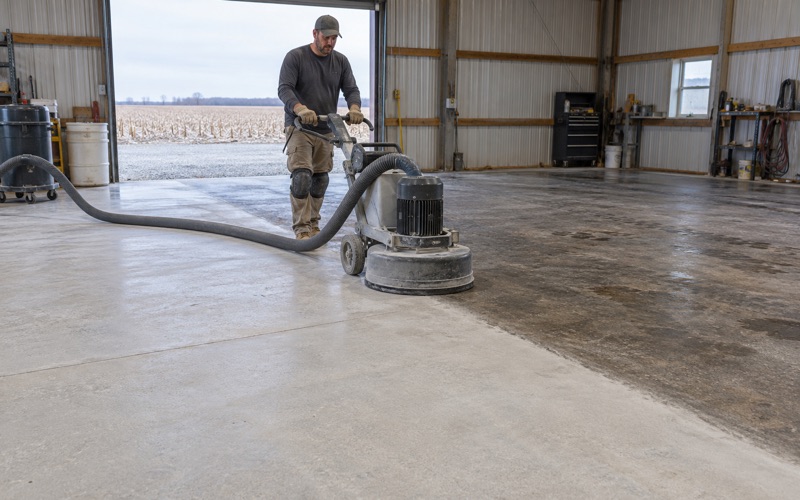
A walk-behind grinder opening up the slab of a farm shop near DeKalb, half ground pale and half still dark.

Concrete Grinding

Diamond grinding and shot blasting that strip old coatings, mastic and sealers and leave a measured profile for the next floor.

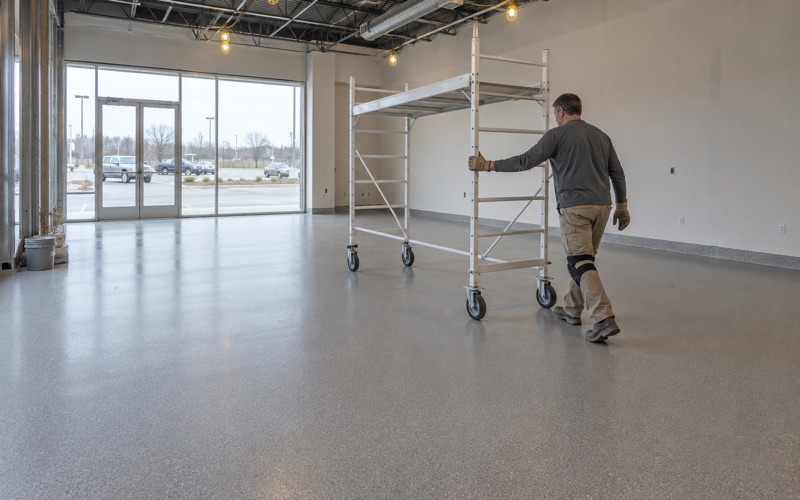
A rolling scaffold moved across a newly coated tenant space floor in a DeKalb shopping center.

Commercial Epoxy Flooring

Epoxy and urethane floors for retail, office, clinic, auto and fitness spaces, scheduled around business hours and specified in writing.

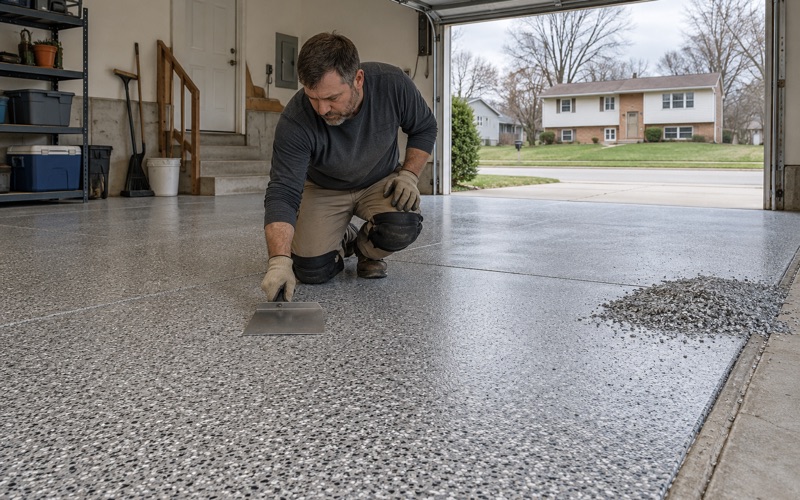
A wide floor scraper run across a set flake broadcast to knock down raised chips in a DeKalb garage.

Flake Epoxy Floor

Full-broadcast vinyl flake floors for garages, basements and shops, chosen from real samples and sealed with a durable clear topcoat.

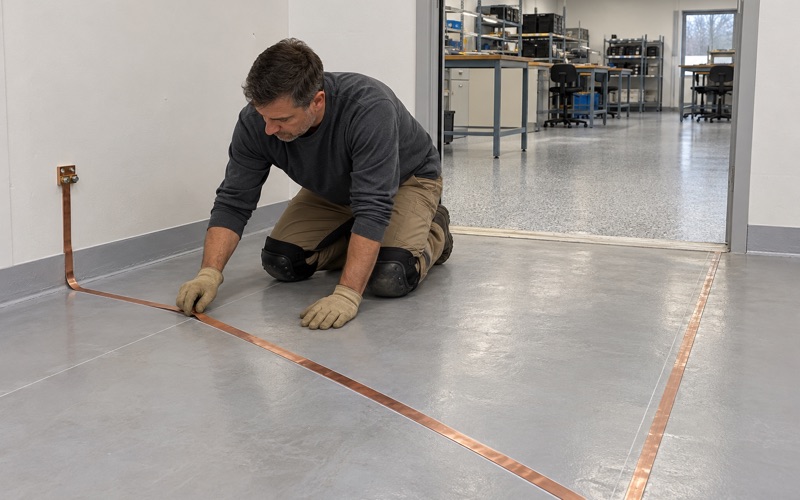
A copper grounding strip pressed onto a primed slab before the static-control floor goes down in a DeKalb electronics room.

Esd Flooring

Static-dissipative and conductive resin floors for electronics, data and lab spaces, grounded, tested and documented after installation.

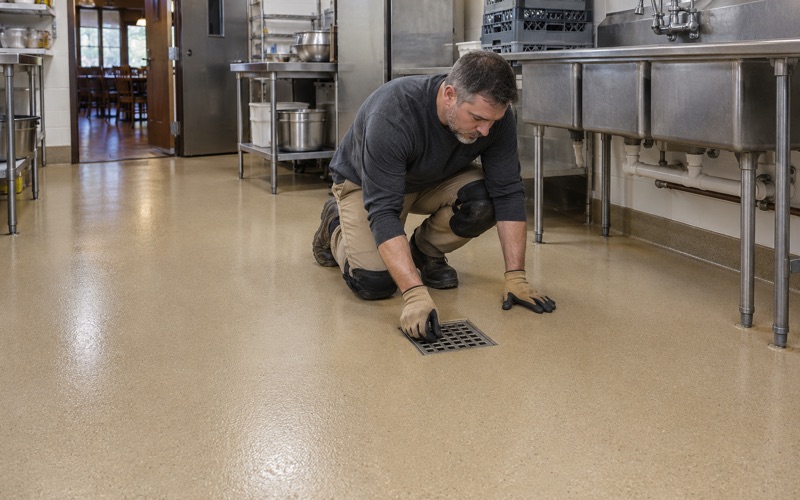
A stainless drain grate set flush into a new urethane cement floor in a DeKalb restaurant kitchen.

Commercial Kitchen Flooring

Urethane cement kitchen floors with coved bases, sloped drains and slip-resistant texture, specified to pass health department plan review.

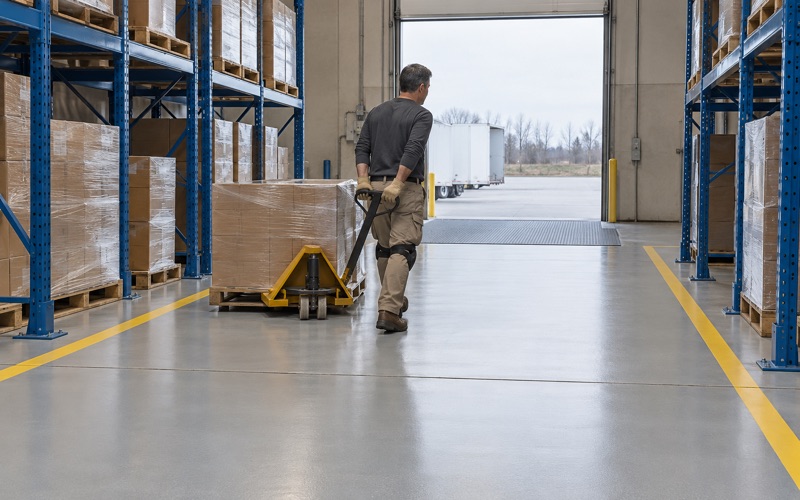
A pallet jack pulled down a striped aisle on a new gray epoxy floor in a distribution warehouse near DeKalb.

Industrial Epoxy Flooring

High-build epoxy and urethane floors for plants, warehouses and farm shops, with joint repair, safety striping and shift-friendly scheduling.

Built on 20+ Years of Floor Coating Work

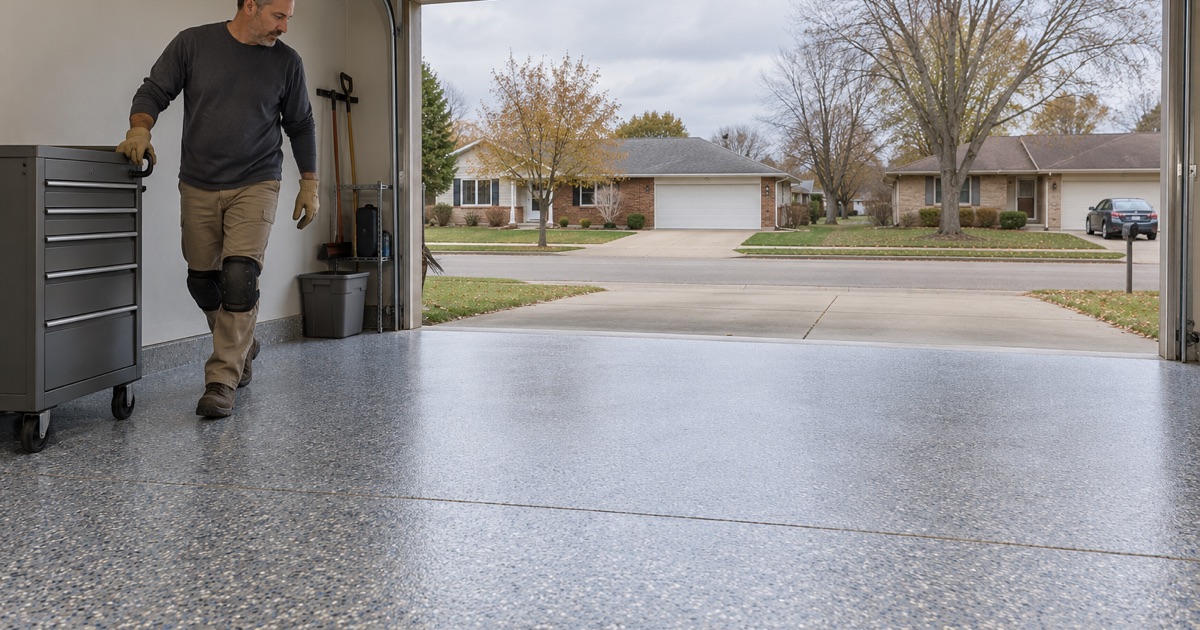
A rolling tool chest wheeled back along the wall of a new blue-gray flake garage floor in a DeKalb ranch house.

20+ Years Installing Concrete Floor Coatings

We have spent more than twenty years grinding, repairing and coating concrete floors, from residential garages and basements to shop floors and commercial kitchens. That time has taught us which slabs take a coating well, which ones need work first, and which conditions make a floor fail. It is the experience behind every recommendation in our proposals.

Why Choose DeKalb IL Epoxy Flooring

Ground Open, Never Etched

Every slab is opened with a diamond grinder or shot blaster to a measured surface profile, so the primer bonds to sound concrete rather than to a sealer, a paint film or acid residue. Rinsing on muriatic acid and rolling on a coating is how a careless crew saves a day, and it is why so many garage floors peel in strips.

Moisture Tested Before Quoting

No coating system is chosen until the slab has been tested, because many DeKalb-area garage slabs were poured with no vapor retarder beneath them. Moisture rising through that concrete pushes a coating off from below, so we test first and specify a mitigation primer where the reading calls for one, rather than learning about the problem from a blister.

Built for Rock Salt and Brine

A northern Illinois winter puts calcium chloride brine and rock salt on every garage floor through the tires and wheel wells. We build garage systems with a full-thickness base and a chemical-resistant topcoat sealed tight at the edges, so the salt has no bare concrete to work into, rather than leaving a thin film that lets brine creep underneath.

Cure Scheduled by the Slab

Curing is scheduled against slab temperature and the dew point spread at the surface rather than the calendar. An unheated garage or machine shed in the DeKalb cold slows a coating’s cure and can draw condensation onto fresh resin, so we tell you plainly when a job has to wait for spring instead of coating a cold slab to fill a schedule.

Written Scope and Contract

Each proposal names the product, the system build and the finished thickness, and every home job gets a written contract and the Home Repair: Know Your Consumer Rights pamphlet before work starts, as the Illinois Home Repair and Remodeling Act requires. That paper trail means the floor installed can be checked against the floor sold.

Local Rules Confirmed First

Illinois issues no state license for flooring or coatings work, so we confirm each city’s or village’s contractor registration, bond and insurance rules before a job is scheduled. DeKalb, Sycamore and the villages around them each handle this differently, and checking first keeps a job from stopping halfway for paperwork.

The Garage Floor, Start to Finish

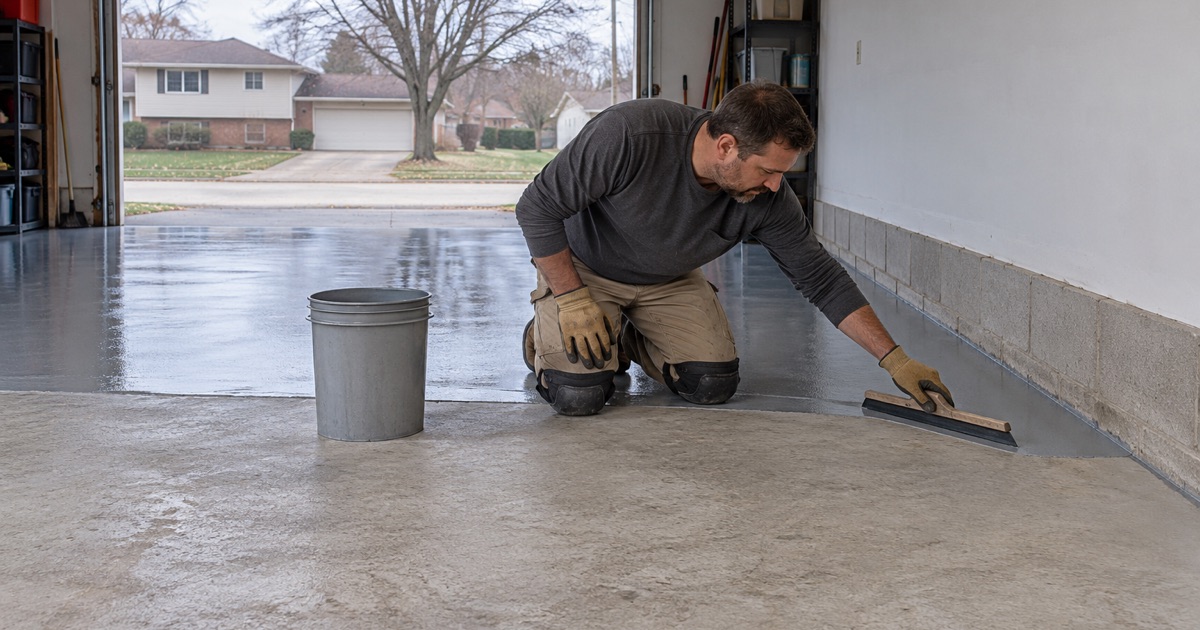
A gray base coat pulled into the wall corner with a hand squeegee on a freshly ground garage slab in DeKalb.

Epoxy Garage Floor Installation, From First Look to Parking Day

An epoxy garage floor job starts with a walk-through of the slab, a moisture test and a look at every crack and joint. Then come grinding, repairs, the base coat, any flake or color broadcast, and the topcoat, usually over two to three working days. We give you a written schedule so you know when the floor takes foot traffic and when it takes your car.

Diamond Grinding Before a Garage Coating

A coating rolled over sealed, painted or smooth troweled concrete has nothing to grip, so it lets go in sheets once hot tires and salt go to work on it. We grind every garage slab with diamond tooling to an ICRI CSP profile the primer is designed for, collecting the dust at the grinder. That open surface is where the bond comes from.

Moisture Testing a Garage Slab With No Vapor Barrier

The residential code lets a garage slab be poured without the vapor retarder required under living space, so many garages have nothing stopping ground moisture. We test with ASTM F1869 calcium chloride kits or ASTM F2170 relative humidity probes, and a quick ASTM D4263 plastic sheet test where it helps. The reading decides whether the slab needs a moisture-mitigation primer.

Reading Garage Floor Cracks Before Coating

A hairline shrinkage crack, a settled slab and a crack that moves with the seasons each need different handling. We look at width, offset and whether the edges have shifted before quoting, then fill stable cracks with a semi-rigid polyurea filler. A crack that is still moving gets honored in the coating rather than hidden, because a coating cannot stop concrete from moving.

Garage Slab Coating Versus Replacement Under DeKalb’s Code

Some garage slabs are too broken, heaved or scaled to coat, and pouring new concrete is the honest answer. DeKalb’s building code, the 2021 I-codes under Ordinance 2024-063, carries the IRC R309.1 requirements for a garage floor that slopes toward the door and a 4-inch curb at the house wall. A replacement slab has to meet those rules, so we flag them before you decide.

Calcium Chloride Brine and Rock Salt on Bare Concrete

Rock salt and calcium chloride brine soak into bare concrete, then freeze and expand in the pores, which flakes the top surface away over a few winters. The salts also stain and leave a white crust. A properly prepared and sealed garage coating keeps that brine on top of the floor, where a squeegee or a hose can move it out.

Coating a Garage Through a Northern Illinois Winter

Epoxy and polyaspartic resins need the slab warm enough to cure and dry enough to bond. A heated, insulated garage can be coated in January, but an unheated one in a DeKalb cold snap cannot hold the temperature. When the conditions are wrong, we put the job on the calendar for spring rather than install a floor that never fully cures.

Epoxy Garage Floor Kits Versus a Professional System

A retail kit is usually a thin water-based epoxy applied over acid-etched concrete, and the hot tire pickup that follows within a year is predictable. A professional job uses diamond grinding, a 100% solids epoxy or polyaspartic base, a full flake broadcast and a durable topcoat. The difference is in the preparation and the film thickness, not the brand on the bucket.

What an Epoxy Garage Floor Costs Per Square Foot

We price garage floors per square foot for the system we actually propose, after looking at the slab. Old coatings that have to come off, deep crack repair, a mitigation primer, full versus partial flake and the topcoat choice all move the number. A national per-garage figure cannot know any of that, so we do not quote one.

Coating Warranty Exclusions, Moisture First

Almost every floor coating warranty excludes failure caused by moisture coming up through the slab, and that exclusion matters most on a garage with no vapor retarder. Hot tire damage on a fresh floor, chemicals left standing and cracks that open later are other common exclusions. We read the list to you before the job is sold.

Polyaspartic Versus Epoxy Garage Coatings

Polyaspartic topcoats cure fast and hold their color in sunlight, while epoxy builds thickness and bonds well as a base. The ‘stronger than epoxy’ claim common in polyaspartic marketing leaves out that a one-day polyaspartic floor still depends on grinding and moisture testing. We often pair the two, and the proposal names which product goes where.

Basements, Sump Pits and Groundwater

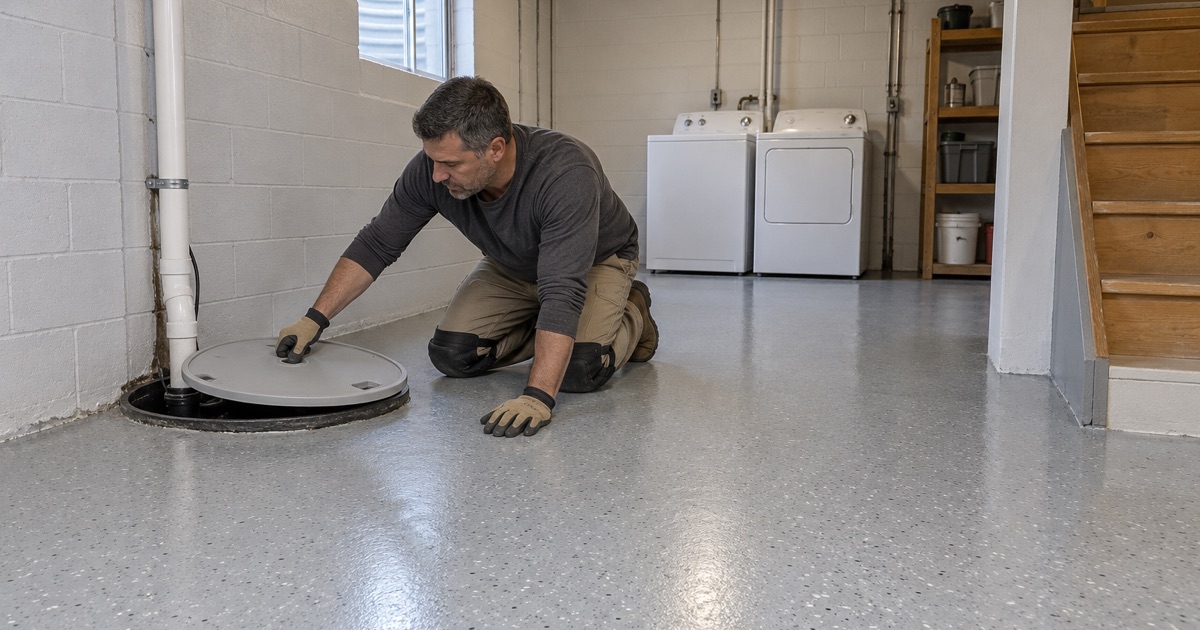
A sump basin lid set back in place on a newly coated light gray basement floor in a DeKalb ranch house.

Basement Floor Epoxy and the Moisture Question

A basement slab sits in the soil, so moisture moves through it in a way a garage floor upstairs never sees. Before we quote a basement floor coating, we test the slab and look at the walls, the floor drain and the sump. The reading decides whether the floor can take a coating as it is, needs a mitigation primer, or needs the water fixed first.

Hydrostatic Pressure Under a Basement Slab

When the water table around a foundation rises, groundwater pushes up against the underside of the basement slab. That pressure drives water and dissolved salts through cracks and pores, and it can lift a coating that was never designed to hold it back. We explain where the pressure comes from and tell you plainly that a coating is not waterproofing.

Efflorescence, the White Powder on a Basement Floor

The white, chalky powder that shows up on a basement floor is efflorescence, salt left behind when water moves through concrete and evaporates. It is a sign that moisture is active in the slab. Any coating applied over it will lose its bond, so we remove the salts mechanically and test the moisture before recommending a system.

Coating Around Sump Pits, Footing Drains and Floor Drains

Sump pits, perimeter drain tile cleanouts and floor drains are where water is supposed to go, so the coating has to stop cleanly at each one without blocking it. We detail the edge of the coating around each opening and keep the slope toward the drain intact. Grinding dust is collected at the grinder and never washed into a floor drain.

Moisture-Mitigation Primers for Basement Slabs

A moisture-mitigation primer is a dense epoxy layer designed to tolerate vapor moving up through a slab that would blister an ordinary coating. Whether a basement needs one is decided by the moisture test against the product’s published limits, often framed around ASTM F710 thresholds. We include the primer in the quote when the reading calls for it.

Kishwaukee River Flooding and Basement Floor Coatings

Parts of DeKalb sit near the South Branch Kishwaukee River floodplain, and a basement that takes water needs to dry out completely before any coating goes down. A coating cannot keep floodwater out, and a slab coated while still wet will fail. We test the slab after a flood and wait for the readings rather than the calendar.

FEMA Flood Damage-Resistant Floor Finishes

FEMA Technical Bulletin 2 classifies flooring materials by how well they survive floodwater, and concrete with a bonded coating sits on the resistant side, unlike carpet or wood. For a basement in a flood-prone area, that means the coated slab can be cleaned and kept after a flood. We explain the classification when you are deciding how to finish a lower level.

Coated Basement Laundry Rooms, Workshops and Home Gyms

A laundry room needs a floor that wipes clean and tolerates water from a leak, while a workshop needs resistance to dropped tools and solvents, and a home gym needs a surface rubber mats will not dent. We match the system to how the room is used. Quartz or flake broadcast adds texture where wet feet or sweat call for grip.

What a Basement Floor Coating Costs

Basement floors are priced per square foot, and the moisture reading moves the number more than anything else, because a mitigation primer adds material and labor. Removing old paint or carpet adhesive, filling cracks and working around a sump or mechanical room also add cost. We quote after testing the slab, so the price reflects the floor you have.

Radon Mitigation and Floor Coatings

A floor coating can seal the surface of a slab, but it is not a radon reduction system, and we do not sell it as one. In Illinois, radon mitigation work requires a license through IEMA, the state emergency management agency. If you are concerned about radon, a licensed mitigation contractor is the right call before the floor is coated.

Color, Flake and Finish

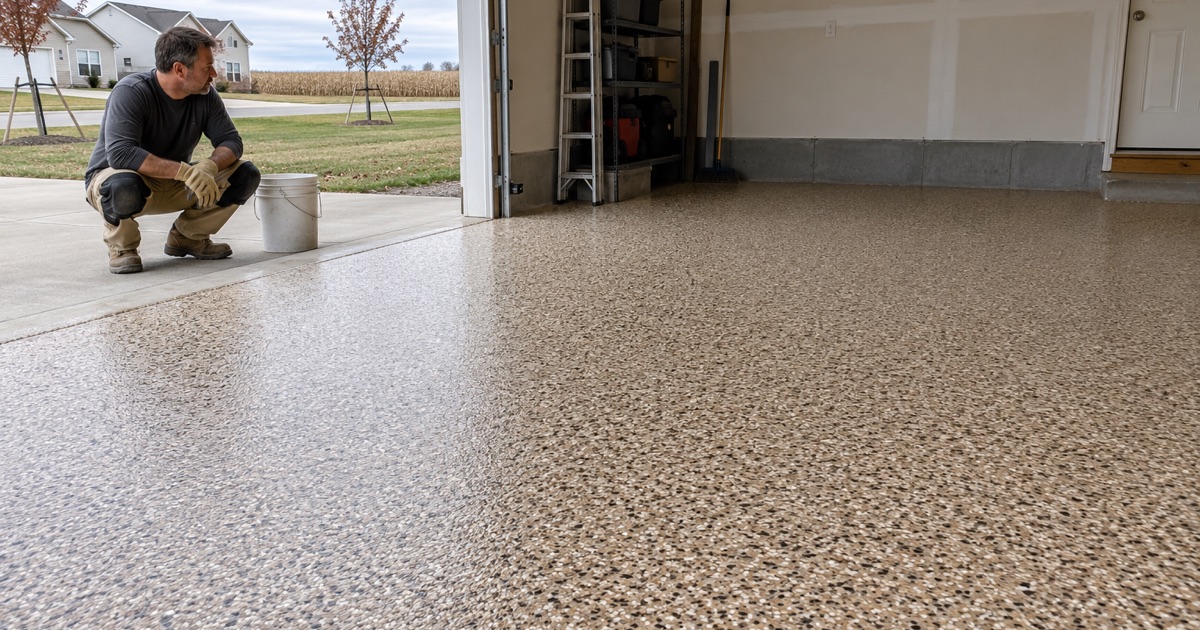
A finisher crouching on the apron to look across a fresh tan, brown and cream flake broadcast in a DeKalb garage.

Vinyl Flake Epoxy Floors, Blends and Chip Sizes

A vinyl flake broadcast scatters colored chips into the wet base coat, which hides small surface flaws and adds texture underfoot. Larger chips read as a bold, speckled pattern, while smaller chips blend into a granite-like look from a distance. We bring blend samples to the walk-through so you can see the color against your garage lighting.

Metallic Epoxy Floor Installation

A metallic epoxy floor uses pigments that swirl and settle as the resin levels, creating a marbled, three-dimensional look. Getting it right means a flawless base, a controlled pour and hand-worked movement before the resin starts to set. It suits basements, showrooms and offices, and we show finished samples so you know how much variation to expect.

Polished Concrete Floors and Aggregate Exposure

Polished concrete is the slab itself, ground and honed through progressively finer diamonds and hardened with a lithium silicate densifier. How deep the grinding goes decides whether the finish shows cream, fine salt-and-pepper aggregate or larger stone. We test a small area first, because every slab reveals different aggregate once it is opened.

Gloss, Satin and Matte Coating Finishes

A high-gloss topcoat looks sharp but shows dust, footprints and tire marks quickly. A satin or matte finish hides everyday dirt and scratches far better, which is why many garage and shop owners choose it. We show you the sheen options in person, so the finish matches how the floor will actually be used.

Quartz Broadcast Floors for Color and Grip

Quartz aggregate broadcast into a resin floor builds color and slip resistance in the same layer. The sand-sized granules lock into the base and are sealed with a clear topcoat, leaving a texture that grips under wet boots. It is a common choice for locker rooms, kitchens and ramps, where a smooth floor would be a hazard.

Solid Color Floor Coatings

A solid color epoxy or polyurethane floor is the simplest system we install, and in a warehouse, mechanical room or work shop it is often the right one. It shows spills and dropped parts clearly and can be striped for traffic lanes. We say so when plain gray suits a space better than a decorative finish.

Ultraviolet Light and Epoxy Ambering

Standard epoxy yellows, or ambers, when sunlight hits it through an open garage door or a window. Polyaspartic and aliphatic urethane topcoats resist that change and keep the color true. Where a floor sees daylight, we specify a UV-stable topcoat over the epoxy base so the floor does not take on a yellow cast.

Saw-Cut Lines, Borders and Inlaid Logos

Saw-cut lines in polished concrete or a coated floor can create tile patterns, borders and walkways. Coatings can also carry a contrasting border, a logo or safety markings laid in between coats. We map the layout with you before work starts, since a cut line in concrete cannot be moved later.

Shops, Farms, Warehouses and Kitchens

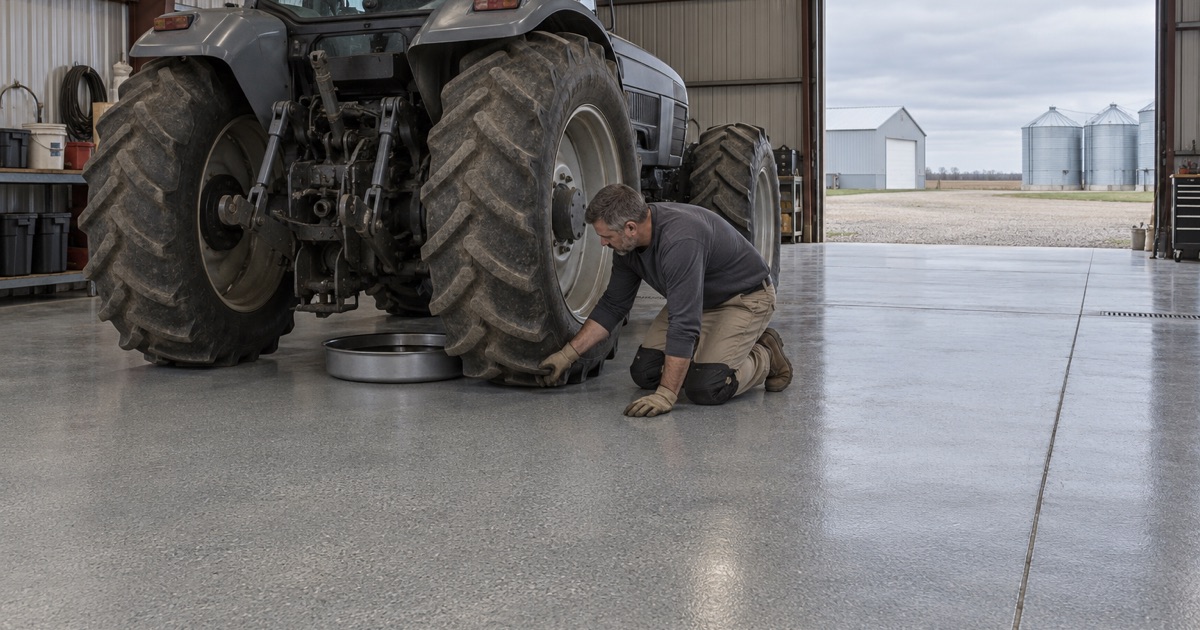
A drain pan slid under a parked tractor on the coated floor of a machine shed outside DeKalb.

Commercial Epoxy Flooring Versus Residential Work

A commercial floor carries heavier traffic, chemicals and code requirements than a garage, and the building often has to keep operating during the job. Systems are thicker, joints and drains need more detailing, and inspections may be involved. We plan commercial projects around the building’s schedule and the specific loads the floor has to carry.

Farm Shop and Machine Shed Floors

A farm shop floor around DeKalb takes tracked-in mud, fertilizer residue, hydraulic fluid and the weight of equipment. We build those floors thick and textured, with a chemical-resistant topcoat and edges sealed against standing water. When a shed cannot be heated through the winter, we schedule the job for warmer months rather than risk a cold cure.

Plant and Distribution Floors Along Interstate 88

Plants and warehouses in Park 88 and ChicagoWest Business Park run forklifts, pallet jacks and racking on their floors every day. We specify high-build epoxy or urethane systems for those loads, with joint treatment that keeps edges from spalling. Scheduling is built around shifts and shipping so the floor work does not stop the building.

Control Joint Filler Under Forklift Traffic

The saw-cut control joints in an industrial slab take a hit every time a hard forklift wheel crosses them. An unsupported joint edge chips and widens, so we fill joints with a semi-rigid polyurea joint filler flush to the surface. The filler supports the edges while still letting the slab move with temperature changes.

Restaurant Kitchen Floors and Health Department Plan Review

A restaurant kitchen floor in DeKalb County goes through DeKalb County Health Department food plan review before the permit is issued. FDA Food Code 6-201.11 calls for smooth, durable and easily cleanable floors, with an antislip exception where safety requires one. We specify the floor system to meet that review, so it is approved before installation.

Coved Bases and Urethane Cement Kitchen Floors

FDA Food Code 6-201.13 calls for coved junctures between floors and walls in areas cleaned by water flushing, so dirt cannot collect in a corner. Urethane cement handles the hot water, steam and grease that would soften an epoxy floor. We install integral coved bases in the same material, sealed where the floor meets the wall.

Storefront and Tenant Space Floors Between Leases

Retail spaces and offices turn over between tenants, and the old flooring often leaves adhesive, patched concrete and anchor holes behind. We grind the slab clean, repair it and install a coating or polished finish quickly so the space can be shown or reopened. The schedule is built around the lease date.

Auto Repair Bay Floor Coatings

Auto repair bays deal with oil, coolant, brake fluid and dropped tools, and lift anchors must stay solid. We use chemical-resistant epoxy or urethane systems and detail the coating around lift bases and trench drains. A textured topcoat adds grip where fluids end up on the floor.

Static-Dissipative and ESD Flooring

Electronics assembly, data rooms and some labs need floors that drain static charge in a controlled way. Static-dissipative and ESD flooring systems use conductive layers and grounding points to hold the floor within a specified resistance range. We test the installed floor against that range and document the results.

Illinois VOC Limits on Floor and Industrial Coatings

The Illinois limits in 35 Illinois Administrative Code Part 223 Subpart C cap the VOC content of floor coatings and industrial maintenance coatings, and they bind the contractor applying them as well as the maker. They sit alongside the national architectural coatings rule in 40 CFR 59 Subpart D. We choose products within those limits for every job.

Overnight and Weekend Commercial Floor Installation

Shops, warehouses, kitchens and farm operations often cannot shut down for days. We schedule grinding and coating overnight, on weekends or in sections, so part of the building stays in use while the rest is coated. Fast-curing polyaspartic systems help when the floor has to return to service quickly.

Areas We Serve

DeKalb IL Epoxy Flooring provides epoxy-flooring throughout the greater DeKalb area, with the same crews and the same standards on every job.

Good to know

Frequently Asked Questions

How long does an epoxy garage floor take from start to finish?

Most two-car garages take two to three working days, covering grinding, crack repair, the base coat, flake or color, and the topcoat. Foot traffic usually comes back within a day of the final coat, and vehicles a few days after that, depending on the system and the slab temperature. We give you the schedule in writing before work starts.

Do you acid etch concrete before coating it?

No. Every slab we coat is opened mechanically with a diamond grinder or a shot blaster, which removes sealers, paint and the weak top layer and leaves a measured surface profile. Acid etching leaves residue and an uneven profile, and it is a common reason garage coatings peel. Mechanical prep costs more time, but it is the step the rest of the floor depends on.

Is a moisture test really necessary on a garage floor?

Yes, because many garage slabs were poured with no vapor retarder under them, which the residential code allows. Moisture moving up through the concrete can push a coating off from underneath, and most manufacturer warranties exclude that failure. We test before we quote a system, so the choice of primer and coating is made on a reading rather than a guess.

What affects the price of an epoxy floor in DeKalb?

The main factors are the square footage, the condition of the slab, how much crack and joint repair it needs, whether an old coating has to come off, and which system is chosen. A moisture-mitigation primer adds cost when a slab needs one. We quote per square foot for the system actually proposed, after looking at the floor, rather than from a national average.

Does Illinois require a license for floor coating contractors?

Illinois issues no state license for flooring or coating work, so the rules come from each city or village. Some require contractor registration, a bond or proof of insurance, and some require a permit for certain jobs. We confirm the local requirements for your address before scheduling, and every home job gets a written contract as the Illinois Home Repair and Remodeling Act requires.

Can you coat a floor in the winter?

We can coat a heated garage, basement or building through the winter, because the slab and the air stay in the range the products need. An unheated garage or machine shed is different, since a cold slab slows the cure and can pull condensation onto the surface. When a space cannot be held warm and dry, we tell you plainly that the job should wait for spring.

Which is better for a garage, epoxy or polyaspartic?

Each has a place. Epoxy builds thickness and bonds well as a base coat, while polyaspartic cures faster and resists ultraviolet light, which suits a topcoat in a garage with the door open to the sun. Many of our garage floors use both, and the proposal names which product goes where so the choice is visible.

What does a floor coating warranty usually not cover?

The most common exclusion is moisture coming up through the slab, followed by damage from hot tires on a fresh floor, chemical spills left standing, and cracks that open after installation. We read the exclusions to you before the job is sold rather than after a problem shows up. That conversation is a large part of why we test moisture first.

Will an epoxy coating stop water in my basement?

No. A floor coating is not waterproofing and will not stop groundwater pushing up through a slab or seeping in at the walls. If water is getting into the basement, the source has to be dealt with first, usually through grading, gutters, drain tile or a sump system. Once the slab is dry and tested, a coating can protect and finish it.

Ready to Get Started?

Request a free quote today and we'll get back to you fast.