
DeKalb IL Epoxy Flooring provides concrete grinding in DeKalb, IL, serving surrounding cities including Cortland, Sycamore, Genoa, Elburn and Rochelle. In more than 20 years of floor work, grinding has been the step we refuse to shortcut, because every coating, polish or sealer is only as good as the surface it is bonded to.
Grinding removes what should not be there, such as sealers, paint, adhesive, oil and the weak top layer of the slab, and leaves a clean, open surface. It can also flatten lips and high spots that create trip hazards. Done well, it is the part of a floor job you never see and always depend on.
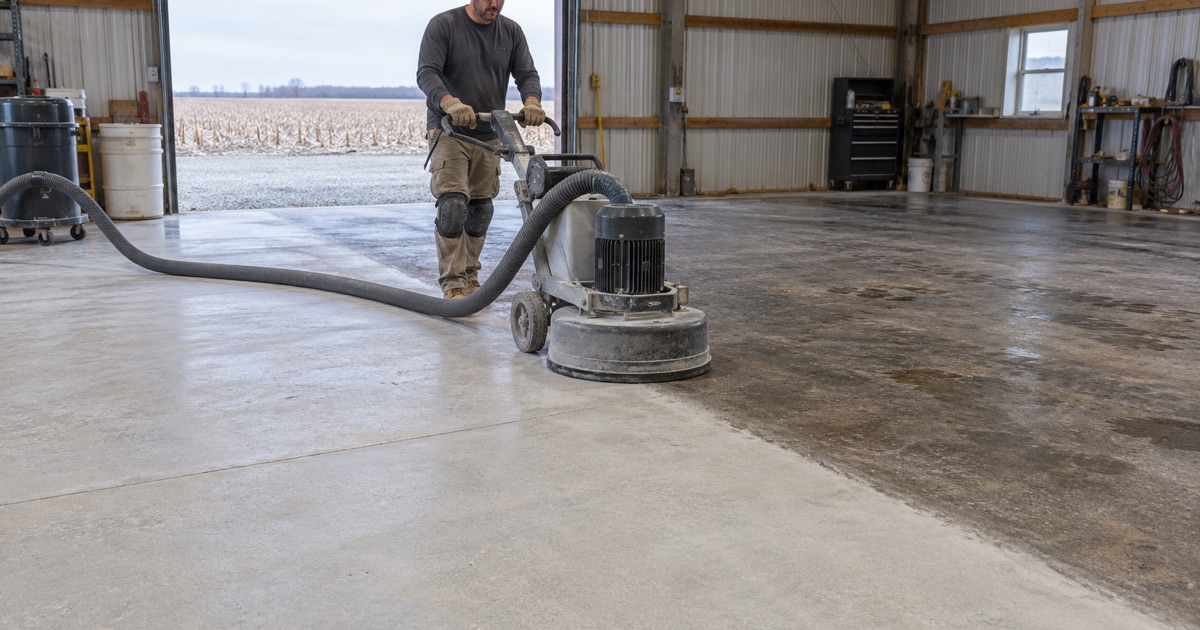
We grind as part of our own coating and polishing jobs, and as a standalone service for owners and other trades who need a slab stripped and prepared. Either way, we collect the dust at the grinder and leave a profile that matches what the next product needs.
Why We Grind Instead of Acid Etching
What Acid Etching Leaves Behind
Acid etching is the method most retail coating kits recommend, and it is a common cause of peeling garage floors. The acid reacts only with exposed cement paste, so it does nothing to sealers, curing compounds, paint or oil soaked into the slab. It also leaves an uneven, shallow profile.
If the acid is not completely neutralized and rinsed, salts and residue stay in the surface and weaken the bond. Etching also puts acid-laden water onto the floor and toward drains. We do not acid etch any floor we coat.
What Mechanical Preparation Does Instead
Diamond grinding and shot blasting remove the contaminated and weak top layer physically, whatever it is made of. They produce a consistent texture that a primer can grip across the whole floor. The surface is dry and ready to coat as soon as it is vacuumed.
That consistency is what makes a bond predictable. A floor ground to the right profile behaves the same in the middle of the garage as it does at the door, which is exactly what a coating needs.
Grinding and Shot Blasting Methods
Diamond Grinding
Planetary diamond grinders use rotating heads fitted with metal-bond or resin-bond diamond tooling. Coarse tooling removes coatings and opens the surface, while finer tooling refines it for polishing. Grinding works well on garages, basements and most commercial floors, and it can reach close to walls.
The tooling is matched to the hardness of the concrete and the material being removed. Soft concrete with a hard coating on top needs a different setup than hard, bare concrete. Getting that match right keeps the work efficient and the profile even.
Shot Blasting
Shot blasting throws small steel shot at the slab, which chips away the surface and leaves a rougher texture. The shot is recovered and reused, and the dust is pulled into a collector. It is fast on large open floors, such as warehouses and shops.
Shot blasting creates a heavier profile than light grinding, which suits thick coatings and overlays. It is less suited to small rooms and edges, so we often combine it with grinding on the same job.
Edges, Corners and Tight Spaces
Large machines cannot reach the last few inches along walls, around posts, at the garage door track or under stairs. We grind those areas with hand grinders fitted with diamond cup wheels, also connected to dust collection. Edges are where coatings most often start to lift, so they get full attention.
The edges and the open floor should end up with the same profile. A floor ground well in the middle but only scuffed at the edges will fail at the perimeter first.
What Concrete Grinding Removes
Old Coatings, Paint and Sealers
Failing paint, peeling epoxy and old sealers have to come off before a new floor goes down, since the new system would only be as strong as the old film’s bond. Grinding takes them off completely and exposes clean concrete beneath. Thick coatings may take several passes.
We look at the existing coating before quoting removal, because a thin paint film and a thick industrial coating take very different amounts of time. The proposal lists removal as its own line.
Adhesive, Mastic and Thinset
When carpet, vinyl tile or ceramic tile comes up, it usually leaves adhesive or thinset behind. Grinding removes it so the slab can be coated, polished or covered with a new floor. Gummy adhesives are slower to remove than hard residue.
Some older black mastics may contain asbestos. We ask about the age of the flooring and recommend testing before grinding any suspect material, since that removal is regulated work.
High Spots, Lips and Laitance
Grinding can take down raised edges at cracks, ridges from poor finishing and small high spots that create trip hazards. It also removes laitance, the weak, powdery layer that forms on the surface of some slabs as they cure. Coatings bonded to laitance peel off with it.
Low spots cannot be ground up, so we fill them with a patching or self-leveling material after grinding. The goal is a floor that is sound, flat and clean before anything goes on it.
Surface Profile and Dust Control
Measuring the Surface Profile
The International Concrete Repair Institute defines surface roughness on a scale from ICRI CSP 1, nearly flat, to CSP 10, very rough. Each coating manufacturer specifies the profile its product needs, and thin coatings need a lighter profile than thick overlays. We grind to the profile the chosen product calls for.
We compare the finished surface against standard ICRI profile chips. That turns surface preparation into something you can check rather than something you take on trust.
Dust Collection at the Grinder
Concrete dust contains crystalline silica, which is why every grinder and hand tool we run is connected to a dust collector with filtration. The dust is captured at the tool and bagged for disposal. We never wash grinding dust toward a floor drain or storm inlet.
We also seal doorways and keep the work area separated from the rest of a home or business. Cleanup includes vacuuming the slab so the next coat goes onto a clean surface.
- 20+ Years of Floor Work
- Moisture Testing in Every Scope
- Written Proposals and Contracts