
DeKalb IL Epoxy Flooring installs basement floor epoxy in DeKalb, IL, serving surrounding cities including Cortland, Sycamore, Genoa, Elburn and Rochelle. After 20+ years of coating concrete, we start every basement job with one question: where is the water coming from? The answer decides whether the floor can be coated and what the system has to include.
A basement slab sits in the soil, so it deals with moisture in a way an upstairs floor never does. Vapor moves up through the concrete, groundwater can push against the underside, and salts ride along with the water to the surface. A coating chosen without accounting for that is one of the most common floor failures we are called to look at.
We are plain about what a coating can and cannot do. It can turn a dusty, stained basement slab into a clean, durable floor for a laundry room, workshop or family space. It cannot stop water, and we say so before anything is sold.
Finding the Water Before Coating a Basement
Hydrostatic Pressure Under the Slab
When the water table around a foundation rises after heavy rain or snowmelt, groundwater presses up against the bottom of the basement slab. That pressure can push water and dissolved salts through cracks and pores in the concrete. A coating laid on top is not built to hold that pressure back, and it will eventually blister or peel.
We look for the signs of that pressure during the walk-through, including damp patches after storms, staining along cracks and water at the wall joint. If the slab is taking liquid water, the source has to be addressed before a coating makes sense. Coating over it only hides the problem for a season.
Efflorescence and Mineral Salts
Efflorescence is the white, chalky crust that collects on basement floors and walls. It forms when water carries salts through the concrete and leaves them behind as it evaporates. Its presence tells us moisture is moving through the slab.
Any coating applied over efflorescence will bond to the loose salt rather than the concrete. We grind it away completely and then test the slab, since the salts will return under a coating if the moisture is still active. The test decides whether a mitigation primer is needed.
Sump Pits, Drain Tile and Floor Drains
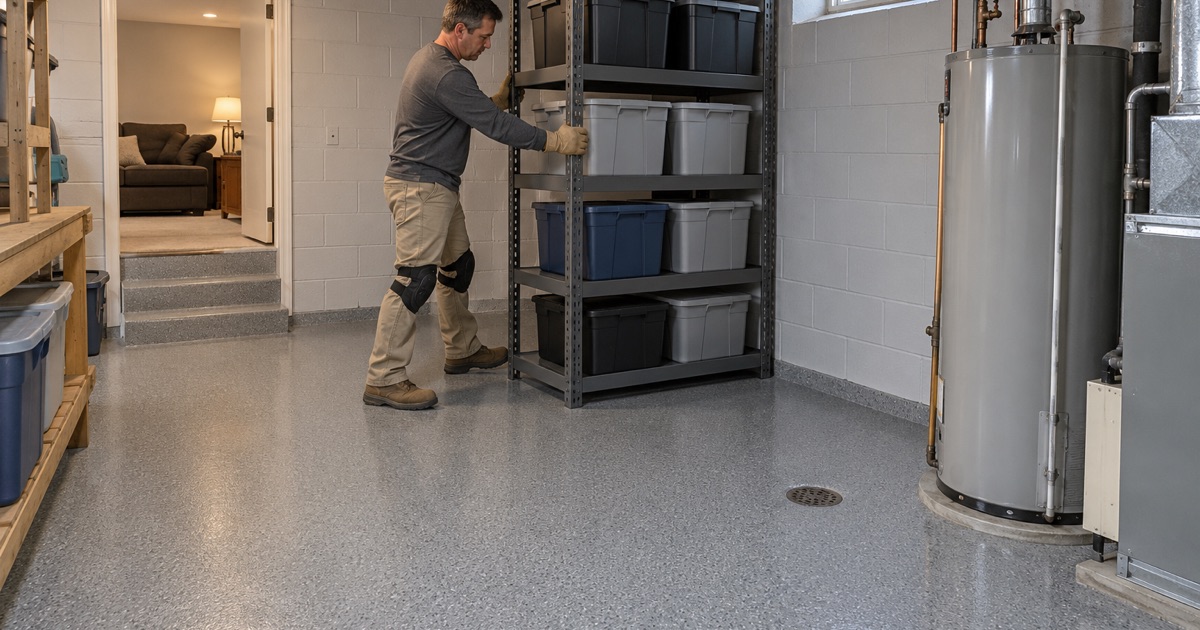
Many DeKalb basements have a sump pit fed by perimeter drain tile, plus a floor drain near the laundry or furnace. Those openings are where water is supposed to go, so a coating has to stop cleanly at each one without blocking it. We grind and detail the edge around every opening.
The slope toward the floor drain is kept intact, so water still runs where it should. Grinding dust is collected at the grinder and never rinsed into a drain. If the sump pit cover or drain grate needs to come up for the work, we plan that ahead.
Testing and Choosing a Basement Floor System
Moisture Testing the Slab
We test basement slabs with ASTM F1869 calcium chloride kits, which measure how much vapor the slab gives off, or ASTM F2170 probes set into the concrete to read relative humidity. A quick ASTM D4263 plastic sheet test can show whether moisture is reaching the surface. The readings are recorded in your proposal.
Coating manufacturers publish moisture limits for their products, often framed around ASTM F710 thresholds. A slab under those limits can take a standard system, and a slab over them needs mitigation. Testing turns the decision into a number rather than a guess.
Moisture-Mitigation Primers
A moisture-mitigation primer is a dense epoxy layer engineered to tolerate vapor coming up through the slab without blistering. It goes down directly on the ground concrete, and the rest of the system is built on top of it. For many basements, it is the difference between a coating that lasts and one that lifts.
The primer adds material, labor and a cure period, so it affects both the price and the schedule. We include it when the test calls for it rather than adding it to every job or leaving it out to lower the quote. You see the reading that justified the choice.
Flake, Solid Color and Metallic Basement Floors
A flake system hides small flaws and gives texture underfoot, which suits laundry rooms and storage areas. Solid color coatings are simple and bright, while metallic epoxy creates a marbled, polished look that suits finished family rooms and bars. Each one sits on the same tested, prepared slab.
We bring samples to the walk-through so you can see colors under your basement lighting, which is usually dimmer than a garage. Lighter colors can brighten a dark lower level considerably. The proposal names the finish, the layers and the finished thickness.
Basement Rooms and How They Are Used
Laundry Rooms, Workshops and Home Gyms
A laundry room floor needs to handle water from a leaking washer and detergent spills, so it gets a seamless system with a textured topcoat. Workshops need resistance to dropped tools, oil and solvents. Home gyms need a surface that will not dent under weights and stays grippy when sweat lands on it.
We match the system to the room rather than using one product everywhere. Quartz or flake broadcast adds grip where floors get wet, and a chemical-resistant topcoat protects workshop floors. The result is a basement that works as hard as the rest of the house.
Finished Living Space on a Coated Slab
Some homeowners want a coated slab as the finished floor of a family room or home office. Metallic and solid color finishes look polished and are easy to clean, and they work well with area rugs. Unlike carpet, a coated floor does not hold moisture or odors if the basement ever takes water.
We talk through comfort before coating living space, since a coating does not warm the slab. Rugs, furniture placement and lighting all matter. A coated floor is also a good base if the room’s use changes later.
Floods, Radon and What a Coating Cannot Do
Kishwaukee River Flooding and FEMA Guidance
Parts of DeKalb lie near the South Branch Kishwaukee River floodplain, and some basements have taken water during high water. FEMA Technical Bulletin 2 lists concrete with a bonded coating among the flood damage-resistant materials, which means a coated slab can usually be cleaned and kept after a flood. Carpet and many other finishes cannot.
After a flood, though, the slab has to dry out fully before any new coating goes down. We test the slab and wait for the readings to drop rather than going by the calendar. Coating a wet slab after a flood is one of the fastest ways to lose a floor.
Radon and Floor Coatings
A floor coating seals the surface of the slab, but it is not radon mitigation, and we never present it as one. In Illinois, radon mitigation requires a license from IEMA. If a radon test shows elevated levels, a licensed mitigation contractor should install a system.
Ideally, that system goes in before the floor is coated, so the suction pit and piping are planned around the finished floor. We are happy to coordinate timing so the two jobs do not get in each other’s way.
Our Step-by-Step Basement Floor Epoxy Process
Step 1: Water Check and Moisture Test
We look for the water’s path, check the sump, drains and walls, and test the slab. You see the readings, and the proposal names the system that fits them.
Step 2: Grinding and Repair
Paint, efflorescence and the weak top layer are ground away with dust collection running. Cracks and pits are filled and ground flush, and the edges around drains are detailed.
Step 3: Primer, Base Coat and Finish
The primer or moisture-mitigation primer goes down first, followed by the base coat, any broadcast and the topcoat. Each layer cures before the next is applied.
Step 4: Walk-Through and Care
We walk the finished floor with you and confirm when furniture can move back in. You also get care instructions for cleaning the floor and keeping drains clear.
- 20+ Years of Floor Work
- Moisture Testing in Every Scope
- Written Proposals and Contracts